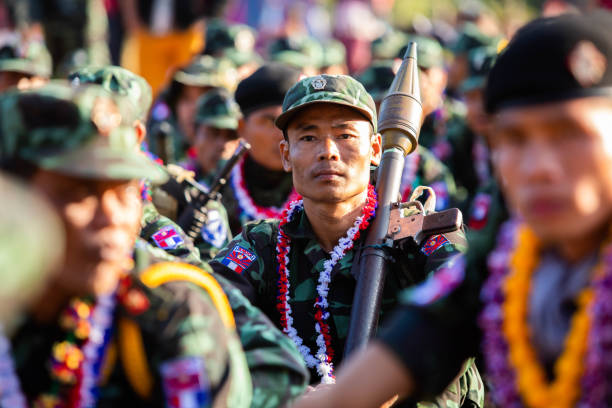
As the conflict in Myanmar escalates, the opposition forces, united under the Brotherhood Alliance, have taken significant strides in their resistance against the military government. Formed by three major ethnic opposition groups—the Arakan Army (AA), the Ta’ang National Liberation Army (TNLA), and the Myanmar National Democratic Alliance Army (MNDAA)—this alliance has ramped up its offensive since the beginning of the year, reclaiming numerous towns and provinces. However, despite these successes, the military junta has been regrouping with the help of foreign support, particularly through the acquisition of UAVs (unmanned aerial vehicles) and drones from Russia and China.
The Brotherhood Alliance: Ethnic Unity and Ideological Goals
The Brotherhood Alliance represents three key ethnic groups that have long been marginalized under successive Myanmar regimes:
- Arakan Army (AA): Fighting for greater autonomy for the Rakhine State, the AA aims to establish a confederate system in which the ethnic Rakhine people can govern themselves. They emphasize self-determination and oppose the centralization of power in Naypyidaw.
- Ta’ang National Liberation Army (TNLA): Representing the Palaung people, the TNLA’s goal is to secure greater political rights and economic development for its region, with a strong stance against the Myanmar military’s control over their lands and people. They also hold a pro-socialist vision, advocating for wealth redistribution and community-focused governance.
- Myanmar National Democratic Alliance Army (MNDAA): Primarily operating in the Kokang region, the MNDAA fights for ethnic Kokang autonomy and seeks to reestablish a system of local governance that emphasizes civil rights and freedoms for its people.
These groups, while each rooted in distinct ethnic grievances, share the common goal of overthrowing Myanmar’s military dictatorship and establishing a decentralized federal system where minority groups can govern their regions freely.
The Surge in Opposition Attacks and Retaking of Territories
Since the beginning of 2024, the Brotherhood Alliance has launched numerous coordinated offensives, regaining control over several strategic areas. Some of the most significant gains include:
- Lashio in Shan State: A key town in northern Myanmar, strategically important for its proximity to trade routes with China.
- Muse: Also in Shan State, this town serves as a vital trading hub, and its recapture by opposition forces has disrupted military supply lines.
- Kyaukme: Another strategic location in northern Shan State, which the TNLA has focused on to secure access routes through the mountainous terrain.
- Myawaddy in Kayin State: Located along the Thai border, Myawaddy’s recapture has granted opposition forces an advantage in terms of both supply lines and tactical positioning against the military.
These gains have allowed opposition forces to not only reclaim territory but also weaken the regime’s grip on economically vital regions. The Brotherhood Alliance has focused on disrupting the regime’s supply routes, particularly in border areas, further isolating military-controlled regions.
Military Junta’s Drone Warfare and Foreign Support
As the conflict intensifies, the military government has responded with increased reliance on UAVs and drones, primarily sourced from Russia and China. These drones have been used extensively for surveillance, targeted strikes, and logistical support, giving the junta an aerial advantage in certain areas. Russia has provided Myanmar with reconnaissance drones, while China’s supply of combat UAVs has significantly boosted the junta’s capacity to conduct precision airstrikes on opposition strongholds.
The regime’s reliance on foreign-supplied UAVs marks a shift towards modern warfare tactics, compensating for the shortcomings of its ground forces, which have been spread thin across multiple fronts.

(Image used under the Creative Commons Attribution-ShareAlike License from Wikipedia, based on the article Myanmar Civil War. Available at: Myanmar Civil War – Wikipedia.)
The Regime’s Counteroffensive: Mobilizing Volunteers and Conscripts
In response to the increased pressure from the opposition, the military junta has regrouped and launched counterattacks, particularly in regions like Shan and Kayin States. A key element of their strategy has been the recruitment of fresh forces. As of mid-2024, the regime has conscripted and enlisted over 15,000 volunteers, many of whom are expected to join the frontlines by the end of the year.
This new wave of fighters has bolstered the regime’s capacity to resist the Brotherhood Alliance’s advances. The junta’s focus has shifted to defending key urban centers, reinforcing strongholds in Naypyidaw and Mandalay while attempting to reclaim lost territory. This regrouping has slowed down opposition gains in recent months, with several major offensives being halted or repelled.
The Ideological Battlefield: Visions for Myanmar’s Future
While the military junta clings to centralized authoritarian rule, the Brotherhood Alliance’s vision is of a federal Myanmar where ethnic minorities have greater autonomy and control over their regions. Their ideology is built on the foundation of self-determination, civil rights, and, in some cases, socialist principles of wealth redistribution and collective governance. Each of the three opposition groups—AA, TNLA, and MNDAA—fights for the rights of their people but shares a broader goal of ending the military’s stranglehold on power.
The junta, on the other hand, maintains its vision of a unitary state, one in which the military controls the political, economic, and social spheres. Their fear of decentralization and loss of control fuels their aggression against the Brotherhood Alliance and other opposition forces.
Conclusion: A War Shaped by Technology and Ideology
The Myanmar Civil War has entered a new phase, marked by both the increased use of modern warfare technology and the deepening ideological divide between the junta and the Brotherhood Alliance. While opposition forces have made significant gains, the military regime has adapted with foreign assistance, halting their advances in recent months.
As both sides continue to regroup, it remains to be seen whether the Brotherhood Alliance’s vision for a decentralized Myanmar will prevail over the junta’s entrenched authoritarianism. What is clear, however, is that the conflict is far from over, and the future of Myanmar will be shaped by the relentless struggle between these opposing forces.

 Orion's Compass
Leave a comment