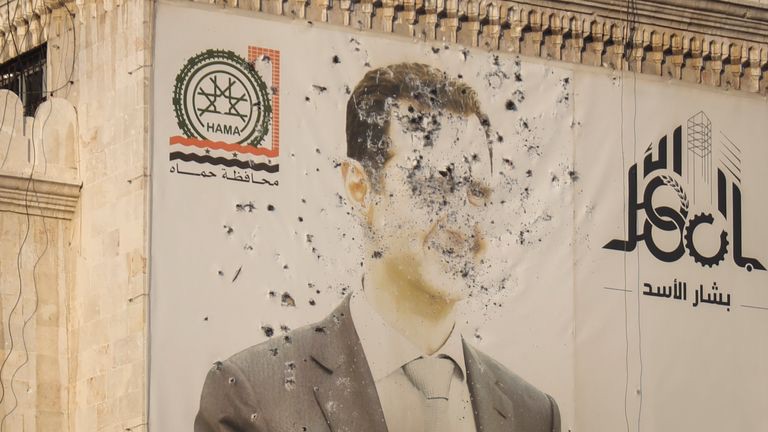
The Offensive Begins: A Build-Up in the East
The recent developments in Syria did not emerge overnight. Over the past few weeks, I have noticed increasing movements and friction in Eastern Syria, particularly in regions like Deir ez-Zor and its surroundings. These were not isolated incidents but the early signs of a broader offensive. Rebel forces began testing regime defenses in smaller areas, probing for weaknesses and identifying vulnerable positions. As clashes intensified, it became clear that this was more than just localized skirmishing, other began saying the same thing. I knew something was brewing.
What began in the east soon gained momentum, evolving into a massive, coordinated push against the Assad regime and its Security Forces. The rebels capitalized on regime overstretch, forcing the Syrian army to withdraw from key posts, particularly in regions where support and resources had dwindled. This escalation, combined with parallel advances in Idlib and Aleppo, laid the foundation for the current rebel offensive that now directly threatens the Syrian capital, Damascus.

Encircling Damascus: North and South Collapsing
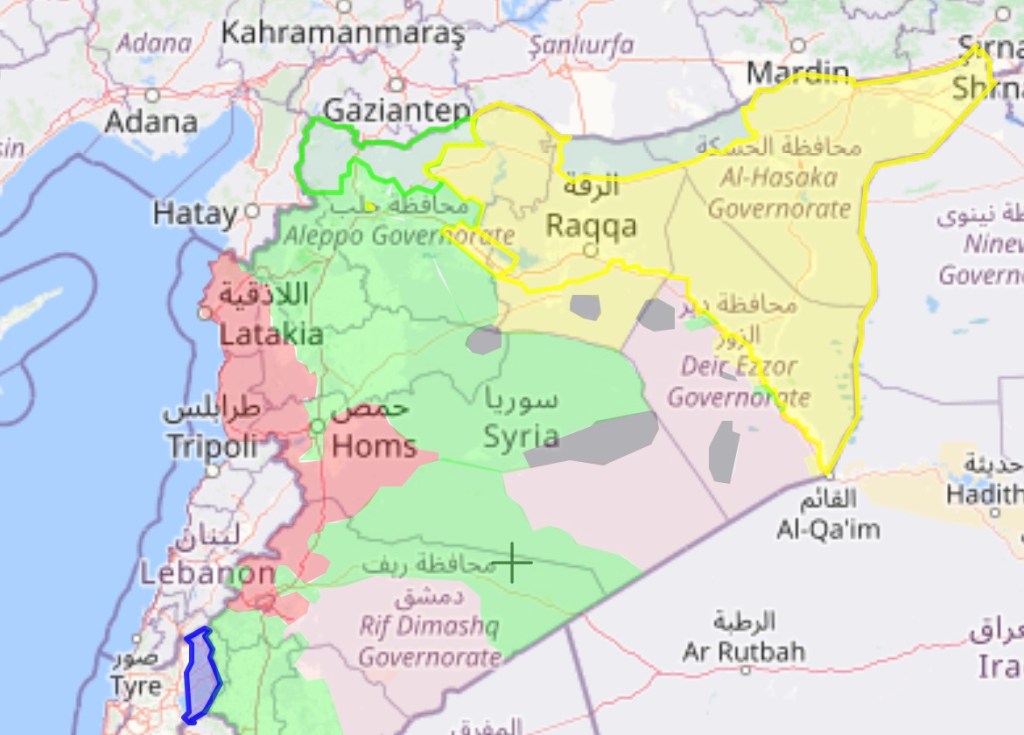
The rebels’ strategy appears quite clear: Isolate and encircle Damascus. As of 1730 CST on 12/07/2024 this effort has been remarkably successful so far to the north and south of the city. In the north, rebel forces led by organized coalitions like Hayat Tahrir al-Sham (HTS) and aligned factions have seized control of significant ground, closing off key access routes to the capital. Reports from the Midan district show that opposition advances are not just military but also fueled by a resurgence of civilian unrest. Historically a hub of anti-Assad protests, Midan is now a focal point for mobilization, with civilians openly challenging the regime’s remaining control.
To the south, the situation is equally dire for Assad’s forces. Regime troops have abandoned posts in strategic areas, including sections of the Al-Mazzah district and the surrounding countryside. Recent reports highlight mass evacuations of key government infrastructure, such as military airports and command buildings, with troops withdrawing to the city center. This retreat reflects the growing inability of Assad’s forces to maintain defensive lines, as the rebels successfully cut off vital supply chains leading into Damascus.

Walking Through the Offensive: A Coordinated Push
The offensive began with smaller skirmishes in the east, where regime forces, stretched thin by economic collapse and years of conflict, were unable to mount effective defenses. From there, the momentum carried into the northwest, support from Turkish Forces and rebel factions capturing strategic towns like Qabtan al-Jabal, and pushing closer to government-held areas in Aleppo’s countryside. This multi-front approach forced the Assad regime to divert resources, weakening its hold over Damascus.
The significance of Damascus cannot be overstated. As the political and symbolic heart of the regime, its encirclement signals the impending collapse of Assad’s rule. By effectively cutting off the northern and southern approaches, the rebels are squeezing the capital, forcing the regime to rely on increasingly limited supply lines. This strategy mirrors historical sieges, where isolation often leads to both military and psychological collapse.
Yellow – Kurdish Forces
Green – Rebel Forces/ Opposition Forces
Red – Assad Regime Forces
The Role of Extremist Groups
While the rebel offensive is a remarkable demonstration of coordinated action, it comes with significant concerns. Groups like HTS and remnants of ISIS have played a critical role in the offensive, embedding themselves within larger opposition forces. Their integration raises troubling questions about Syria’s future stability. As Damascus weakens, extremist factions are well-positioned to exploit the chaos, consolidating power in liberated regions and potentially undermining the broader goals of moderate opposition forces.
The risk of extremist dominance looms large, particularly in areas where governance has already broken down. Without clear leadership and international intervention, liberated territories could become breeding grounds for jihadist movements, much like what occurred during ISIS’s rise in the mid-2010s.
A Regime on Its Last Legs
What we are witnessing is not just a series of isolated victories but the unraveling of Assad’s regime. The combination of military setbacks, civilian unrest, and international isolation has pushed Damascus to the brink. Rebel forces have adopted a strategic, multi-front approach, steadily closing in on the capital and breaking the regime’s once strong hold.
The regime’s reliance on external backers, particularly Russia and Iran is also showing cracks. Russia’s focus on Ukraine has diverted critical military resources, while Iran has overstretched its militias in the last year due to growing resistance in other countries. Russia has been a key player in Syria in recent weeks, launching air strikes and drone attacks against rebel forces. Their goal is to halt the ongoing offensive so that they may evacuate their Naval Forces and resources that have been stationed at their Naval Base in Tartus, used for a decade to project power in the Middle East and one of Russias few assets to project power on the global stage, it is also the only Russian Naval base in the Mediterranean. Satellite imagery already shows most of Russias assets have evacuated the base, this will be a major blow for Russia in the region and will be felt domestically it may even possibly affect the Russo-Ukrainian War. The diminishing support from these allies has accelerated the regime’s collapse, leaving Assad with limited options.
A Reckoning for Assad’s Atrocities
The fall of the regime represents more than a military defeat; it signals the end of a regime that inflicted untold suffering on its people. Assad’s forces have been repeatedly accused of using chemical weapons against civilians, most notably the 2017 sarin gas attack on Khan Shaykhun and the 2018 Douma chlorine attack. These atrocities prompted a coordinated international response, including U.S. missile strikes ordered by former President Donald Trump and backed by NATO allies.
These strikes were a rare moment of global consensus, underscoring the international community’s outrage over war crimes that targeted Syria’s most vulnerable. The regime’s collapse now marks a chance for accountability, giving hope that such atrocities will never again go unanswered.
What Comes Next
If Damascus falls, and currently the trajectory suggests it will; the Assad regime’s rule will effectively end. However, the aftermath will be anything but straightforward. Syria will face the immediate challenge of filling the power vacuum left behind. With rebel factions ranging from moderate opposition groups to extremist coalitions, internal power struggles are almost certain.
The international community will need to step in quickly to prevent extremist elements from hijacking the victory. Reconstruction efforts will require massive international aid, while governance will demand an inclusive and unified leadership that can stabilize the country. The return of refugees and displaced Syrians in the region and over seas will depend on the restoration of security and basic infrastructure. It will be a difficult situation to handle the influx of people returning if it does stabilize. The UN will be need to play a key role for the hope of a more stabilized nation.
In Conclusion
The rebel offensive that began with friction in the east has grown into a nationwide push to encircle and isolate Damascus. Successes in the north and south have accelerated the regime’s collapse, with reports of widespread defections and retreats across key positions. Now while the fall of Assad appears imminent, the challenges ahead remain profound. The risk of extremist resurgence, regional interference, and internal divisions could derail the promise of a new Syria.
As the situation unfolds, Syria stands on the cusp of transformation, its future uncertain but no longer tied to Assad’s authoritarian grip.
For continuous updates and developments, follow Liveuamap Syria Tracker, much of the current information is unfolding here. It is a very accurate battleground map, updated by locals in the area and has a very high accuracy on current accounts.
 Orion's Compass
Leave a comment